Logo for Dr Anna Clemens PhD who teaches scientific writing courses for researchers

“The best decision I could ever have made for my PhD” — Case study with Geetika Chauhan

(If video isn’t being displayed, please enable cookies.)

This blog post is based on my podcast interview with Geetika Chauhan, a member of the Researchers’ Writing Academy. To listen or watch the podcast, click play on the YouTube video above or listen to the episode on Spotify or Apple Podcasts

Hello, writers!

I’m excited to speak with you again today. This time, I have a special guest: Geetika Chauhan, a PhD student in geophysics based in Warsaw, Poland, and member of the Researchers’ Writing Academy, and I’m thrilled to have her on the podcast to share her experience.

Today, we’ll dive into why she joined the academy, what she enjoys most about it, and what kept her engaged with this academic writing course. Fun fact: Geetika has a stack of online courses she bought but never watched, so she was initially skeptical about joining another one. You’ll learn what made her engage with this course and actually implement what she learned.

How Geetika Chauhan went from stuck on her 10th draft to getting her paper approved in 2 months by spending less time writing and following a streamlined writing process instead.

Geetika, you’re such an amazing member of the Researchers’ Writing Academy. You joined a few months ago and are always bringing great energy to our Feedback Calls and Co-Writing Sessions. Can you share what motivated you to join the Academy?

It was a really difficult time for me. I was on my tenth draft of a paper and realised I wasn’t making progress. I needed help. Initially, I thought it was my English, but academic English isn’t anyone’s first language (as you always say). So I realised I needed support.

I found your profile on X and wanted to buy the course right away, but I was skeptical. Online courses can be lonely, and sometimes you purchase them and never finish. After following you for about a month, I decided to go ahead and purchase the course.

I wasn’t making progress. Academic English isn’t anyone’s first language. So I realised I needed support.

Why this Scientific Writing Course didn’t end up in Geetika’s pile of unfinished online courses

When you joined, what was your first step?

I went through the modules, but before that, I downloaded the app we use for the course access, community and the whole program. I also joined the different community spaces and familiarised myself with them. That’s how I got started before diving into the modules.

Were there any other concerns before joining?

I was worried about buying the course and not completing it. But after joining, I was pleasantly surprised by the engaging community. It was fun and motivating!

Joining the academy was the best decision I could make for my PhD.

Mostly, I was worried about buying the course and not completing it. I feared it would just end up in my pile of unfinished online courses. But after joining, I was pleasantly surprised by the engaging community. It was fun and motivating! Joining the Academy was the best decision I could make for my PhD.

I agree — the Researchers’ Writing Academy community is really special!

Promo graphic for our free scientific writing course

What made this scientific writing course different from others that you did not finish?

The community is key. We have many co-writing sessions, and knowing someone is there keeps me accountable. Writing sprints are another highlight. It’s encouraging to know others are working alongside you. It feels like being in a real class, but online.

The community is key. It’s encouraging to know others are working alongside you. It feels like being in a real class, but online.

That’s why I now call it a “program” rather than just an online course — the community is such a essential part of it.

Exactly. You also provide advice throughout the week and hold Sunday’s accountability posts, which is very motivating for me.
Promo graphic for our free scientific writing course

How Geetika went from struggling with her paper through 10 drafts to getting her draft approved in 2 rounds

Since joining, how has your writing process changed? You mentioned earlier you were sitting on your tenth draft and things were not going so well. Can you paint the picture of how the program changed the way you write and impacted the quality of your papers?

It has changed drastically. I was struggling with my tenth draft of this paper, but after going through the modules, I started a fresh draft. It was approved by my PI after just two rounds! The course helped me finish in 2–3 months, which was amazing compared to my previous struggles.

I mean, the course is one thing, but you really put in the work. And, you know, you took the lessons and actually applied them. You went back and scrapped everything, right? You had already worked on drafts and drafts, and then you just started with a completely blank page and began from scratch. I mean, a lot of people hesitate to do that because they feel — they don’t dare — throwing away what they’ve already created. It’s this kind of, like, sunken cost fallacy: you feel like, “Oh, I’ve invested so much in this draft already; if I throw it away, I’ll lose even more.” So, I just want to say — it’s really brave to do that.

Can you maybe also speak a bit more about, before you had the course, when you were writing these ten drafts — how did that process go? What was the situation like? Did you receive feedback from your PI? And also, what kind of headspace were you in? How did it feel — what was the experience like at that time?

Oh, it was really frustrating, I think, for both my PI and myself. I was writing these drafts, and my PI was rejecting them. I really appreciate that they were so patient, because even they knew it was my first time writing something like this.

After joining the academy, I realised that I don’t need to write all week. I can focus on writing just three times a week, for two or three hours at a time, which works really well for me.

It got to a point where we both realised that it couldn’t continue this way — I needed to approach things differently. I could feel it myself: I needed a change. Even when I had a proper writing schedule for myself, sometimes I would write all day and end up using just one sentence, or even only part of one. That was really frustrating.

But after joining the Academy, I realised that I don’t need to write all week. I can focus on writing just three times a week, for two or three hours at a time, which works really well for me. So, yeah, it’s been a big improvement.

Fantastic. I’m so glad to hear it. So you did finish this one draft, right? You started from scratch, and within two or three months, you had a finished draft, ready for submission.

Yes. And then, finally, I’m going to submit it, which is a really great achievement for me, I would say.

Congrats! Talking about the Researchers’ Writing Academy, which component helps you the most?

Writing sprints. Writing sprints are my favourite!

Writing sprints are my favourite!

What is an Academic Writing Sprint and why do they work so well?

Do you want to explain what a writing sprint is to those who aren’t familiar, or how we’ve been doing them?

So, basically, in the writing sprint, we schedule it for two weeks, during which we are free to write on the days we feel like writing. We have to break down our tasks into smaller tasks because we have a checklist that allows us to track our progress throughout.

We start each writing sprint with a meditation for the day, and we have co-writing sessions. We also have an open Zoom for co-writing dates. Then we have daily check-ins to see how everyone is progressing throughout the sprint, which I think is really helpful for everyone.

So far, we have had two sprints, and I really enjoyed them. I did a lot of things and was very involved in the first Writing Sprint. The second was a bit chaotic because of summer and everything going on, but I enjoyed it even more than the first because this time we had an open Zoom call and co-writing dates with others in the community, which was really fun.

Note from Anna: If you got curious about the Researchers’ Writing Academy, I recommend watching our free training class (it’s free and takes about 1 hour). It’s the same training that helped Geetika decide to join us and then get the paper approved by her PI that she struggled with for months and months. 👇🏻

Promo graphic for a free academic writing program

Who Would Benefit from the Scientific Writing Course

Who would you recommend to join the Researchers’ Writing Academy? Who do you think it would be a good fit for? And what would you say to those on the fence, thinking, “I’m not sure if I should join”?

Like I said before, it’s one of the best investments I could have made for my PhD. There are certain things you need to follow to write a manuscript, and it’s all very clearly explained. I also really like how you explain concepts using movies — for example, Jurassic Park. It’s really fun and helps everyone understand without relying on technical language. It was really enjoyable.

The Researchers’ Writing Academy is one of the best investments I could have made for my PhD

Thanks, Geetika! I’m really glad to hear that. I can’t wait to see how your writing will continue to get more and more streamlined!

If you’re a PhD student who is ready to use a structured writing process that gets your drafts approved by your PI right away (or if you are a PI who would like to get submission-ready drafts from your PhD students), you shouldn’t waste more time editing and rewriting and join the Researchers’ Writing Academy.
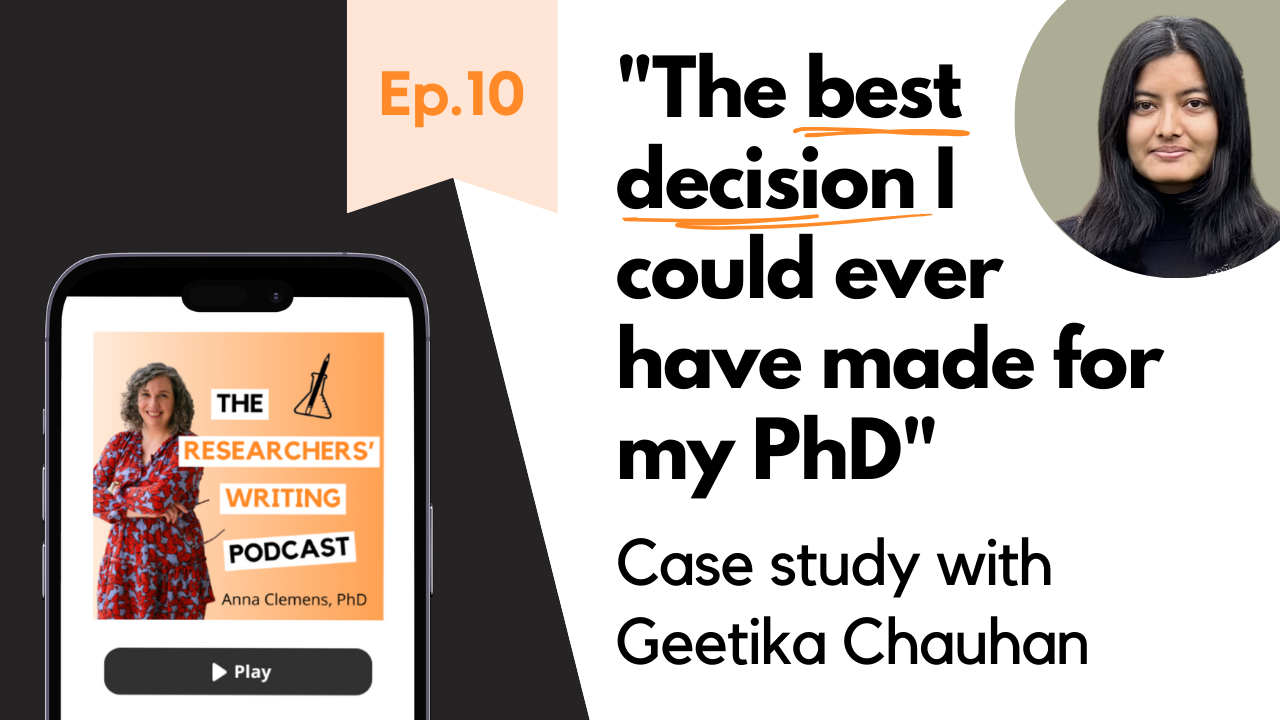


“The best decision I could ever have made for my PhD” — Case study with Geetika Chauhan

(If video isn’t being displayed, please enable cookies.)

This blog post is based on my podcast interview with Geetika Chauhan, a member of the Researchers’ Writing Academy. To listen or watch the podcast, click play on the YouTube video above or listen to the episode on Spotify or Apple Podcasts

Hello, writers!

I’m excited to speak with you again today. This time, I have a special guest: Geetika Chauhan, a PhD student in geophysics based in Warsaw, Poland, and member of the Researchers’ Writing Academy, and I’m thrilled to have her on the podcast to share her experience.

Today, we’ll dive into why she joined the academy, what she enjoys most about it, and what kept her engaged with this academic writing course. Fun fact: Geetika has a stack of online courses she bought but never watched, so she was initially skeptical about joining another one. You’ll learn what made her engage with this course and actually implement what she learned.

How Geetika Chauhan went from stuck on her 10th draft to getting her paper approved in 2 months by spending less time writing and following a streamlined writing process instead.

Geetika, you’re such an amazing member of the Researchers’ Writing Academy. You joined a few months ago and are always bringing great energy to our Feedback Calls and Co-Writing Sessions. Can you share what motivated you to join the Academy?

It was a really difficult time for me. I was on my tenth draft of a paper and realised I wasn’t making progress. I needed help. Initially, I thought it was my English, but academic English isn’t anyone’s first language (as you always say). So I realised I needed support.

I found your profile on X and wanted to buy the course right away, but I was skeptical. Online courses can be lonely, and sometimes you purchase them and never finish. After following you for about a month, I decided to go ahead and purchase the course.

I wasn’t making progress. Academic English isn’t anyone’s first language. So I realised I needed support.

Why this Scientific Writing Course didn’t end up in Geetika’s pile of unfinished online courses

When you joined, what was your first step?

I went through the modules, but before that, I downloaded the app we use for the course access, community and the whole program. I also joined the different community spaces and familiarised myself with them. That’s how I got started before diving into the modules.

Were there any other concerns before joining?

I was worried about buying the course and not completing it. But after joining, I was pleasantly surprised by the engaging community. It was fun and motivating!

Joining the academy was the best decision I could make for my PhD.

Mostly, I was worried about buying the course and not completing it. I feared it would just end up in my pile of unfinished online courses. But after joining, I was pleasantly surprised by the engaging community. It was fun and motivating! Joining the Academy was the best decision I could make for my PhD.

I agree — the Researchers’ Writing Academy community is really special!

Promo graphic for our free scientific writing course

What made this scientific writing course different from others that you did not finish?

The community is key. We have many co-writing sessions, and knowing someone is there keeps me accountable. Writing sprints are another highlight. It’s encouraging to know others are working alongside you. It feels like being in a real class, but online.

The community is key. It’s encouraging to know others are working alongside you. It feels like being in a real class, but online.

That’s why I now call it a “program” rather than just an online course — the community is such a essential part of it.

Exactly. You also provide advice throughout the week and hold Sunday’s accountability posts, which is very motivating for me.

Promo graphic for our free scientific writing course

How Geetika went from struggling with her paper through 10 drafts to getting her draft approved in 2 rounds

Since joining, how has your writing process changed? You mentioned earlier you were sitting on your tenth draft and things were not going so well. Can you paint the picture of how the program changed the way you write and impacted the quality of your papers?

It has changed drastically. I was struggling with my tenth draft of this paper, but after going through the modules, I started a fresh draft. It was approved by my PI after just two rounds! The course helped me finish in 2–3 months, which was amazing compared to my previous struggles.

I mean, the course is one thing, but you really put in the work. And, you know, you took the lessons and actually applied them. You went back and scrapped everything, right? You had already worked on drafts and drafts, and then you just started with a completely blank page and began from scratch. I mean, a lot of people hesitate to do that because they feel — they don’t dare — throwing away what they’ve already created. It’s this kind of, like, sunken cost fallacy: you feel like, “Oh, I’ve invested so much in this draft already; if I throw it away, I’ll lose even more.” So, I just want to say — it’s really brave to do that.

Can you maybe also speak a bit more about, before you had the course, when you were writing these ten drafts — how did that process go? What was the situation like? Did you receive feedback from your PI? And also, what kind of headspace were you in? How did it feel — what was the experience like at that time?

Oh, it was really frustrating, I think, for both my PI and myself. I was writing these drafts, and my PI was rejecting them. I really appreciate that they were so patient, because even they knew it was my first time writing something like this.

After joining the academy, I realised that I don’t need to write all week. I can focus on writing just three times a week, for two or three hours at a time, which works really well for me.

It got to a point where we both realised that it couldn’t continue this way — I needed to approach things differently. I could feel it myself: I needed a change. Even when I had a proper writing schedule for myself, sometimes I would write all day and end up using just one sentence, or even only part of one. That was really frustrating.

But after joining the Academy, I realised that I don’t need to write all week. I can focus on writing just three times a week, for two or three hours at a time, which works really well for me. So, yeah, it’s been a big improvement.

Fantastic. I’m so glad to hear it. So you did finish this one draft, right? You started from scratch, and within two or three months, you had a finished draft, ready for submission.

Yes. And then, finally, I’m going to submit it, which is a really great achievement for me, I would say.

Congrats! Talking about the Researchers’ Writing Academy, which component helps you the most?

Writing sprints. Writing sprints are my favourite!

Writing sprints are my favourite!

What is an Academic Writing Sprint and why do they work so well?

Do you want to explain what a writing sprint is to those who aren’t familiar, or how we’ve been doing them?

So, basically, in the writing sprint, we schedule it for two weeks, during which we are free to write on the days we feel like writing. We have to break down our tasks into smaller tasks because we have a checklist that allows us to track our progress throughout.

We start each writing sprint with a meditation for the day, and we have co-writing sessions. We also have an open Zoom for co-writing dates. Then we have daily check-ins to see how everyone is progressing throughout the sprint, which I think is really helpful for everyone.

So far, we have had two sprints, and I really enjoyed them. I did a lot of things and was very involved in the first Writing Sprint. The second was a bit chaotic because of summer and everything going on, but I enjoyed it even more than the first because this time we had an open Zoom call and co-writing dates with others in the community, which was really fun.

Note from Anna: If you got curious about the Researchers’ Writing Academy, I recommend watching our free training class (it’s free and takes about 1 hour). It’s the same training that helped Geetika decide to join us and then get the paper approved by her PI that she struggled with for months and months. 👇🏻

Promo graphic for a free academic writing program

Who Would Benefit from the Scientific Writing Course

Who would you recommend to join the Researchers’ Writing Academy? Who do you think it would be a good fit for? And what would you say to those on the fence, thinking, “I’m not sure if I should join”?

Like I said before, it’s one of the best investments I could have made for my PhD. There are certain things you need to follow to write a manuscript, and it’s all very clearly explained. I also really like how you explain concepts using movies — for example, Jurassic Park. It’s really fun and helps everyone understand without relying on technical language. It was really enjoyable.

The Researchers’ Writing Academy is one of the best investments I could have made for my PhD

Thanks, Geetika! I’m really glad to hear that. I can’t wait to see how your writing will continue to get more and more streamlined!

If you’re a PhD student who is ready to use a structured writing process that gets your drafts approved by your PI right away (or if you are a PI who would like to get submission-ready drafts from your PhD students), you shouldn’t waste more time editing and rewriting and join the Researchers’ Writing Academy.


“The best decision I could ever have made for my PhD” — Case study with Geetika Chauhan

© Copyright 2018-2026 by Anna Clemens. All Rights Reserved. 


Photography by Alice Dix